America’s World Cup run turned from sporting drama into political theater after President Trump called FIFA over Folarin Balogun’s controversial suspension.
- The USMNT had already built real momentum before Balogun’s red card threatened to sideline its leading scorer.
- President Trump called FIFA President Gianni Infantino, and FIFA lifted Balogun’s suspension under Article 27.
- Belgium, UEFA, and the soccer establishment erupted, but Balogun will still take the field for America.
This was supposed to be America’s summer. Forty-eight teams, three nations, the most watched sporting event on the planet landing in American stadiums for the first time since 1994, and the host nation performing at a level that had millions of fans daring to believe something historic was possible. Then, on a Wednesday night in Santa Clara, California, a VAR review changed everything. And within 24 hours, the President of the United States was on the phone to FIFA.
The USMNT arrived at this tournament with real momentum and a real story. By the time the United States dispatched Australia 2-0 in Seattle, the Americans had already opened group play on June 12 with a 4-1 demolition of Paraguay at SoFi Stadium in Los Angeles. Folarin Balogun, who had emerged as the team’s most dangerous offensive weapon, anchored that opener with a brace. Even without an injured Christian Pulisic, the United States kept rolling, clinching the knockout round with a game to spare and winning Group D for only the third time in program history. U.S. Soccer’s own players reacted to winning Group D with the confidence of a team that knew something special was stirring.
The group finale, a 3-2 loss to Turkey with most starters rested, did nothing to dent the optimism. The Americans had collected six points, their highest group-stage total ever. Not bad for a nation the global soccer establishment still loves to treat like a polite guest at somebody else’s party.
When the Round of 32 draw sent the United States against Bosnia and Herzegovina on July 2, the path looked favorable. Balogun made it even more favorable, scoring his third goal of the tournament just before halftime to give the Americans a 1-0 lead. The United States was controlling the match, playing with the composure of a team that belonged on the world stage.
Then came the 64th minute.
Balogun challenged Bosnian defender Tarik Muharemovic in a loose-ball situation, and his cleat dragged down the defender’s leg before catching the defender’s ankle. The referee waved play on. VAR intervened. After a lengthy review, referee Raphael Claus produced a red card.
The Americans, down to ten men, held on to win 2-0, with Malik Tillman adding a second from a free kick after Balogun’s dismissal. They were through to the Round of 16. Their leading scorer was banned for it.
Pochettino was livid on the sideline. “Never was this a red card,” he told reporters afterward. “That was a normal action in football. That happened by accident and it’s never intentional.”
Under standard FIFA rules, a red card in a knockout game triggers an automatic one-match suspension. Every player who received a red card during this World Cup had served that suspension without exception. FIFA officials initially confirmed that the decision could not be appealed and that Balogun would miss the Round of 16 match against Belgium. That appeared to be the end of it.
It was not the end of it.
And speaking of things that should not be complicated, keeping your health strong should not require turning your kitchen into a science lab. Kimchi is one of the world’s most powerful superfoods, but let’s be honest, not everyone wants to eat fermented kimchi every single day. That is why Brightcore created Kimchi One, giving you the benefits of fermented kimchi in a simple capsule with no mess, no taste, and no hassle. Try today and help your body detox, thrive, and age gracefully from within.
Pochettino later framed the issue in pure football terms, arguing the red card was wrong and that the United States had already been punished by playing 35 minutes with ten men. “We were punished enough,” Pochettino said. “It’s 99.9 percent that we all agree it was an unfair card.”
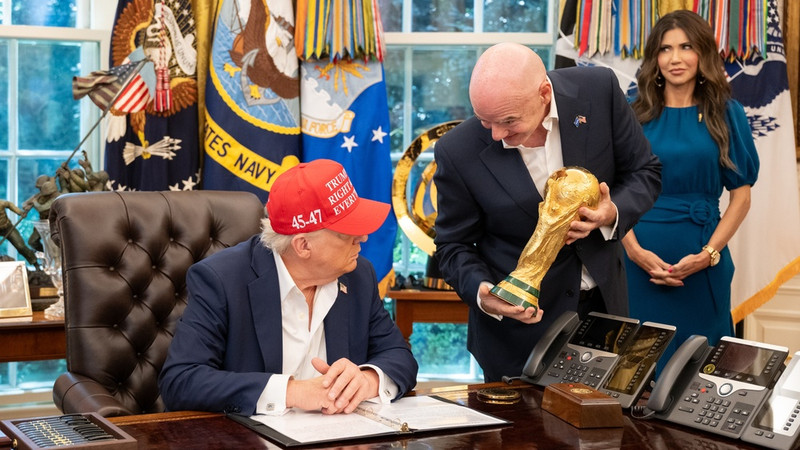
According to multiple reports, including the AP and the Guardian, President Trump placed three calls to FIFA President Gianni Infantino beginning on Wednesday night after the Bosnia match. Trump asked Infantino to review the red card. The White House World Cup task force also reached out to FIFA, as did Commerce Secretary Howard Lutnick.
On Sunday morning, July 5, FIFA announced that Balogun’s suspension had been lifted. The player would instead be placed on one year’s probation under Article 27 of the FIFA Disciplinary Code, with the suspension to be enforced only if he committed a similar infringement during that period.
It was, according to the New York Times, the first time since 1962 that FIFA had permitted a player subject to an automatic World Cup suspension to take the field. Trump celebrated publicly. “Thank you to FIFA for doing what was right, and reversing a great injustice!” he wrote on Truth Social, with the White House account amplifying the message across social media.
Asked whether it was appropriate for Trump to contact Infantino, Pochettino sidestepped cleanly: “We cannot mix that. That is a decision from FIFA.” Translation: the coach was not about to walk voluntarily into the political woodchipper. Wise man.
Belgium, however, did not sidestep. Their federation issued a statement expressing “shock” at the ruling and announced it was “investigating all potential options” to protect its “legitimate rights” and the “principles of fair play.” Head coach Rudi Garcia, speaking at a press conference Sunday, questioned whether July 5 was “meant to be April Fool’s Day” and said Belgium’s mission against the United States on Monday extended beyond football: they were “defending the ethics and integrity of the sport.”
UEFA went further. In a formal statement issued on Monday, UEFA said FIFA had crossed a red line. The statement described the decision as “unprecedented, incomprehensible, and unjustifiable” and warned that by suspending Balogun’s ban mid-tournament, FIFA had called the integrity of the entire competition into question.
And looming behind all of this was the blunt sporting reality: Balogun will play on Monday night in Seattle.
Goalkeeper Thibaut Courtois, seated alongside Garcia, said “nothing changes” regarding Belgium’s preparation. Of course not. Nothing changes, except the opposing team’s leading scorer is suddenly back on the pitch. Other than that, perfectly normal.
“A minimum automatic suspension of one match following a red card is not a discretionary option and does not require the decision of a competent body to be enacted,” UEFA said. “It is a principle embedded in regulations, which cannot be made subject to exceptions.” In other words, Europe had found its sacred text, and it was apparently the FIFA disciplinary code.
Former Liverpool and German national team manager Jürgen Klopp was characteristically blunt. “Trump and Infantino really sorted this out between themselves,” he said. “That’s outrageous. It questions everything.” Former England striker Wayne Rooney called it “an absolute disgrace” on BBC Sport and said Infantino should feel shame.
FIFA maintained that its decision was made in accordance with its own rules, that Article 27 of the Disciplinary Code allows for the suspension of punishments, and that the red card itself remained on Balogun’s record as a formal sanction. Critics noted that the same article had appeared at every previous World Cup, and that no player had benefited from it in this way in over six decades.
Trump’s relationship with FIFA and Infantino has been on open display throughout the tournament. The two men are close, a relationship cultivated over the years that has proven useful to both sides as the United States co-hosts the event. For the administration, the World Cup has been a genuine source of national pride and public enthusiasm in a summer otherwise dominated by harder political battles. For Infantino, access to the White House and a cooperative American government has helped the tournament run smoothly in the most logistically complex host configuration in World Cup history.
Whether Trump’s calls actually changed the outcome or whether FIFA would have reached the same decision through its own internal process is a question that cannot be answered with certainty. FIFA insists politics played no role. The paper trail suggests otherwise. What is clear is that the President of the United States picked up the phone to influence the disciplinary outcome of a sporting event that his country is hosting, and FIFA, under Article 27, found a way to accommodate him.
Whether any of that controversy follows the USMNT into the Round of 16 is now a question for the pitch. The USMNT schedule and standings now carry more than match times; they carry the latest episode in a World Cup run that has somehow become part soccer, part spectacle, and part political earthquake.
Folarin Balogun will play on Monday night in Seattle at 8 pm EST. And just like that, the Trump Card beat the red card.
© 2025 TurleyTalks.com. All rights reserved.
Gain the Clarity, Confidence, and Community you need to lead with courage and awaken a new conservative age. Join the movement to fight back and reclaim freedom at fight.turleytalks.com!