
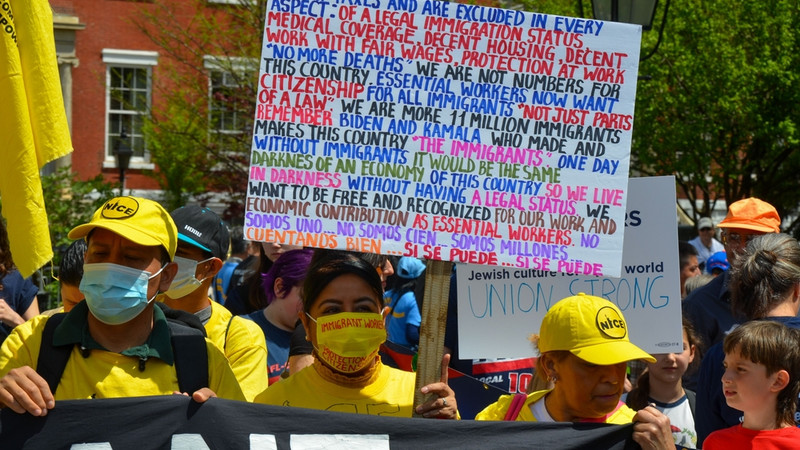
Outside the Supreme Court, the scene captured the emotional weight of the case. Immigration activists, legal advocates, and supporters of the administration’s policy had gathered with sharply different expectations. By a six-to-three vote, the Court gave the Trump administration the green light to move forward with ending Temporary Protected Status for roughly 350,000 Haitians and 6,000 Syrians, a major step in an immigration agenda that has already targeted TPS designations from multiple countries through the Supreme Court’s latest immigration decision.
- The Supreme Court allowed the Trump administration to proceed with ending TPS protections for Haitians and Syrians.
- The ruling strengthens executive authority over immigration decisions tied to foreign policy and national security.
- The decision does not erase the real humanitarian concerns facing migrants who may now be at risk of removal.
Representative Tom Tiffany of Wisconsin summed up the argument for the ruling in a single phrase: the country is finally putting the “T” back in TPS. Temporary Protected Status was created in 1990 to pause deportations for people from countries struck by war, natural disaster, or other extraordinary crises. It was designed as a stopgap, not a permanent immigration category renewed endlessly by one administration after another.
That distinction matters. Haiti has held TPS since 2010, after the devastating earthquake that shattered the country. Syria has held TPS since 2012, during the height of a brutal civil war. The administration’s position was straightforward: a program created for temporary emergencies cannot be allowed to outlive the emergency forever, especially when the law gives the secretary of homeland security authority to determine when conditions have changed.
That was the heart of the Court’s ruling. Justice Samuel Alito, writing for the majority, concluded that courts have limited power to second-guess the Department of Homeland Security’s judgment when it comes to ending TPS designations. That decision cuts against lower court rulings that had slowed or blocked parts of the administration’s plan, including cases involving Haiti and Syria that are now likely to be reconsidered in light of the Court’s decision allowing the administration to remove protections.
The broader question was never just about paperwork. It was about who has the final authority to make immigration decisions tied to foreign policy and national security. Is that power held by elected officials accountable to voters, or by district judges who substitute their own judgment about conditions in Port-au-Prince and Damascus? The Supreme Court’s answer was clear: that authority belongs to the executive branch.
That is why the ruling represents more than a technical win for the Trump administration. It strikes at a pattern that has defined Washington immigration policy for decades, where temporary programs quietly become permanent because no one wants to take political responsibility for ending them. A fourteen-year emergency measure should not need a Supreme Court ruling to expire, but that is exactly what happened.
Still, the case is not as simple as the administration’s victory lap might suggest. Justice Elena Kagan’s dissent raised sharp concerns about motive, pointing to the president’s past comments about Haiti and campaign-era claims involving Haitian immigrants in Springfield, Ohio. The majority did not bless those comments. It held that they were not specific enough to prove that the TPS termination itself was racially motivated, relying on a legal standard similar to the one the Court used in earlier immigration disputes involving the same president.
Reasonable people can disagree with that standard. Even those who believe the executive branch should control immigration policy may still worry that the bar for proving improper motive has been set too high. But the majority’s point was narrower: courts cannot block a lawful immigration decision merely because they dislike the political rhetoric surrounding it.
The human stakes remain very real. Haiti continues to face gang violence, mass displacement, and deep instability. Immigration lawyers also warned the Court about the dangers deportees could face if returned. At the same time, Congress has already shown concern about conditions in Haiti, with a bipartisan House majority voting in April to extend protections for Haitians, even as the measure remained stalled in the Senate. The ruling may settle the legal question of authority, but it does not settle whether ending protections for this population at this moment is wise, humane, or politically sustainable through the ongoing debate over legal protections for Haitians and Syrians.
That distinction is essential. The Supreme Court did not declare Haiti safe. It did not promise that every deportation would be morally clean or practically simple. It decided that the law gives the administration discretion to end TPS when officials determine that the original basis for the designation no longer applies.
The same principle also shaped the administration’s approach to Syria. Whatever the case for granting protection during years of civil war, the government’s argument is that the conditions that originally justified the designation have changed. A temporary program cannot become untouchable simply because ending it is politically painful. That is why the cancellation of TPS for Haitians and the administration’s broader TPS policy have become such a defining test of immigration authority.
The ruling also arrived alongside another immigration-related decision involving border policy, reinforcing the Court’s willingness to give the executive branch room to act in areas where immigration, national security, and foreign policy intersect. For the administration, that is a major legal opening. For immigration advocates, it is a warning that courtroom challenges may no longer be enough to preserve programs that Congress never made permanent through the Court’s immigration rulings on TPS and border metering.
That leaves Congress with a choice. If lawmakers believe Haitians, Syrians, or any other protected population should remain in the United States long term, they have the power to create a more permanent legal pathway. What they cannot do is expect the courts to keep extending a temporary program indefinitely while avoiding the political cost of passing immigration law themselves.
In uncertain times, legal decisions like this remind families how quickly the ground can shift. Whether the concern is immigration, national security, natural disasters, or public safety, preparation matters most when life becomes unpredictable. This tiny orange bag could be the lifeline that keeps you warm, dry, and alive. Be prepared and protect your family! Grab your Emergency Sleeping Bag here.
The Supreme Court’s ruling does not end the immigration debate. It sharpens it. The justices have now made clear that a temporary program cannot be transformed into permanent policy simply through inertia, lawsuits, and political avoidance. If Washington wants permanent protections, Washington must pass permanent law. Until then, the executive branch has been handed the authority to decide when “temporary” really means temporary again.
© 2025 TurleyTalks.com. All rights reserved.
Gain the Clarity, Confidence, and Community you need to lead with courage and awaken a new conservative age. Join the movement to fight back and reclaim freedom at fight.turleytalks.com!
