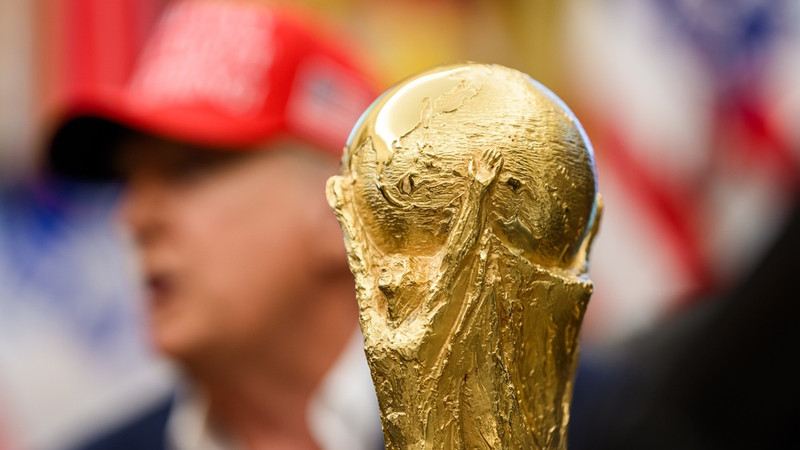
A few weeks before the opening match, a Seattle soccer fan named Lefkowitz tried to explain the strange unease he felt about the tournament his own country was preparing to host. He still wanted the U.S. team to win, but he admitted that everything surrounding that victory felt complicated because of who was in the White House. Asked to summarize his feelings in two words, he answered, “I’m conflicted.” That small moment captured the larger story now unfolding: for many on the left, even a successful American World Cup seems difficult to celebrate without political hesitation.
- A major headline admitted Democrats were struggling with the success of the World Cup.
- Several prominent Democratic officials attended matches but offered little public praise for how well the tournament was going.
- The reaction reveals a deeper political problem: national pride has become conditional when success happens under the wrong administration.
The tension became impossible to ignore when the phrase “Democrats grapple uncomfortably with World Cup success” began making the rounds. Not discomfort with the politics of hosting it. Not simply discomfort with the cost. The discomfort was tied to the success itself. That framing cut straight to the heart of the issue: the tournament’s smooth first two weeks, sold-out stadiums, and massive global audience had forced Democrats who spent months criticizing the preparations to confront a reality that did not fit their preferred narrative.
Before the opening kickoff, Democrats had raised several complaints about ticket prices, funding shortfalls, and the treatment of foreign visitors. Some of those concerns were real policy arguments, and a successful tournament does not automatically erase every criticism. But once the games moved forward without the predicted disaster, the party’s larger problem became obvious. Many Democrats seemed far more comfortable warning about failure than acknowledging success, especially when that success could reflect well on the Trump administration and the country under his leadership.
The silence from several major Democratic names made the moment even more noticeable. Local officials whose cities hosted matches, including New York’s Zohran Mamdani and New Jersey’s Mikie Sherrill, attended games but remained cautious about praising how well things were going. Governors Gavin Newsom and Josh Shapiro also appeared at matches, yet neither offered anything that sounded like direct praise for the people responsible for pulling off the event. That careful silence made the whole situation look less like healthy criticism and more like a party unsure how to respond when America wins in a way that benefits its political opponent.
There was one conspicuous exception. Pennsylvania Congressman Brendan Boyle praised the run of games as a remarkable success and even urged bringing another World Cup back to Philadelphia. But even Boyle felt the need to separate his enthusiasm from the administration, giving credit instead to local host committees. He also noted that immigration enforcement had discouraged some visitors in the lead-up to the tournament, which is a fair point. Still, the fact that praising a major American event required a political disclaimer shows how strange the atmosphere has become.
The discomfort appeared in smaller cultural moments, too. European tourists discovering American staples like Bass Pro Shops became part of the broader spectacle, with visitors visibly enjoying parts of the country that elite media culture often treats as strange or embarrassing. Instead of being received as a harmless and charming culture clash, the reactions exposed something telling: many on the left seem surprised when outsiders genuinely enjoy ordinary American life. The joy of foreign visitors walking through massive sporting venues, packed fan zones, and iconic American stores made it harder to sustain the idea that the country was in embarrassment mode.
To be fair, there is a more generous reading of all this. Refusing to hand political credit to a rival administration is not the same as rooting against the country. Politicians in both parties have often stayed quiet when good news could benefit an opponent. The concerns about ticket costs, funding, visas, and immigration enforcement were not automatically fake just because the tournament has gone well. Local soccer fans also had their own complicated feelings about the event, especially when the politics of soccer fandom collided with the country’s polarized political climate.
But that defense becomes weaker the longer the silence continues. No one needed Newsom, Shapiro, Mamdani, or anyone else to thank the president by name. They simply needed to say that a successful World Cup was good for the country. That should not be difficult. Yet for much of the modern Democratic leadership, even that basic statement seems politically risky. When national pride has to be filtered through partisan calculation first, the issue is no longer just messaging. It becomes a question of whether the left can celebrate America when America succeeds outside its preferred political conditions.
That is why the headline landed so powerfully. It was not framed as a conservative attack line. It was a plain admission that Democrats were uncomfortable with an American success story because the wrong administration might benefit from it. That is also why the reaction became part of a much larger discussion about Democrats and World Cup praise, the media’s difficulty handling the moment, and the strange spectacle of leaders attending games while avoiding the simple words most Americans would expect: this is good for the country.
The issue goes far beyond soccer. When a nation succeeds on the world stage, citizens should be able to celebrate without first checking which party is in power. Healthy patriotism does not require blind loyalty to a president, but it does require enough love for the country to recognize when something good is happening. If political identity makes that impossible, then the problem is not the World Cup. The problem is a worldview that treats American success as suspicious whenever it interrupts the preferred narrative.
The same tension is showing up across the wider culture. There is a growing divide between Americans who still see national success as something worth celebrating and those who seem to view it mainly through the lens of political advantage. That divide helps explain why even positive international attention can become uncomfortable. When foreign visitors enjoy America, when stadiums fill, when cities host successfully, and when the world sees energy instead of decline, it becomes harder to sell the idea that the country is hopelessly broken.
That is what makes this moment so revealing. A successful World Cup should have been easy. It should have been one of those rare moments when Americans across the political spectrum could say, “This is good.” Instead, the left’s reaction has exposed a deeper hesitation. The question is not whether Democrats are allowed to criticize Trump. Of course they are. The question is whether they can still celebrate the country when the country’s success creates an inconvenient political story.
And in uncertain times, moments like this remind us how important it is to support communities that still believe in faith, family, freedom, and the good of the nation.The Patriot Economy is growing. Shop the Turley Talks Store for Patriot Wear and bundle deals that support aligned values and strengthen the movement: Get yours today.
The World Cup has become more than a tournament. It has become a mirror. And what it is reflecting is a political class that can attend the games, enjoy the crowds, and watch the world applaud America, yet still hesitate to say the obvious: this is good for the country. That hesitation may satisfy partisan instincts for a moment, but it reveals a deeper weakness. A movement that cannot celebrate America when America succeeds is not just struggling with messaging. It is struggling with patriotism itself.
© 2025 TurleyTalks.com. All rights reserved.
Gain the Clarity, Confidence, and Community you need to lead with courage and awaken a new conservative age. Join the movement to fight back and reclaim freedom at fight.turleytalks.com!