
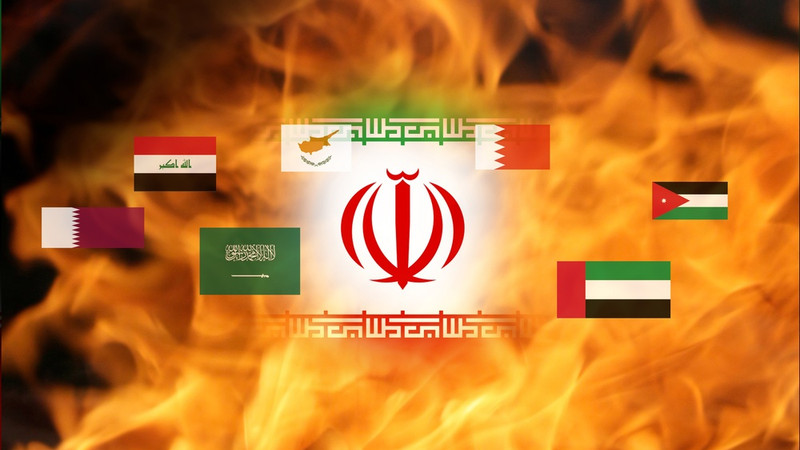
Iran thought it had the perfect strategy: delay negotiations, keep the Strait of Hormuz closed, run out the clock, and watch the MAGA coalition crumble under the weight of sky-high gas prices and an endless war. That was the grand plan—until something unexpected happened. Three phone calls, three Gulf leaders, and an American assault on Iran that was less than a day from launch was suddenly halted.
- The Strait of Hormuz has been closed since late February, causing global oil chaos.
- Gulf states bombarded by Iran now seek a strategic pause in U.S. military action.
- The Abraham Accords' architecture is proving its potency in containing Iran without war.
Since February, the Strait of Hormuz has been effectively closed after American and Israeli strikes decimated Iran's leadership, prompting the IRGC to block the world's most crucial energy chokepoint. This narrow strip, through which 20% of the world's seaborne oil once flowed daily, has remained shut for months. Gas prices in the U.S. have soared, reaching over a dollar more per gallon, with Brent crude briefly hitting $95 a barrel. By late March, Iran had launched over 3,000 attacks on Gulf Arab states, targeting Kuwait, Saudi Arabia, and the UAE with drones and missiles. Just days ago, the UAE had drones near its Barakah nuclear plant, while Saudi Arabia intercepted Iranian projectiles from Iraq.
The Gulf states have been under Iranian attack for months. Yet, in a surprising twist, these same nations requested that he not escalate military action against Iran. Why would Saudi Arabia, the UAE, and Qatar—nations recently used as Iran's target practice—intervene to prevent an all-out American assault? The answer reveals a profound truth about the Middle East that the mainstream media isn't sharing the architecture of the Abraham Accords.
To grasp the Gulf intervention, one must understand the Abraham Accords—not merely as a peace deal, but as a strategic framework. Brokered by Trump in 2020, the Accords were designed as a lasting regional order: Israeli military prowess combined with Arab economic strength and American strategic support to contain Iran without a catastrophic war. The vision was structural deterrence, creating a network of shared interests so intricate that Iran would find itself strategically suffocated—unable to threaten, export terrorism, or enrich uranium. The recent Gulf phone calls to Trump, halting a strike, are not a deviation from this vision but its most sophisticated execution.
Now, amidst this critical moment, it’s essential that patriots like you step up and take action. 👉 Join now and become the patriot leader your community needs. https://turley.pub/PatriotsUnite
The Gulf states didn't call Trump out of sympathy for Iran. These Sunni nations would prefer to see the Shiite radicals eliminated. They called because a full-scale American assault on Iran would destroy the delicate architecture they've been constructing. Consider the implications for the Gulf: Crown Prince Mohammed bin Salman's Vision 2030—a plan for a diversified, post-oil economy—would be derailed by a regional war, scaring off investors and destabilizing the region. For the UAE, with its commercial ties to Iran and a recent $8.4 billion arms deal with Washington, a regional inferno is unthinkable. Qatar, sharing the world's largest natural gas reservoir with Iran, has much at stake as well. These nations have rationally decided that a contained Iran is preferable to a destroyed one. They also signaled to Tehran that any retaliatory attacks on U.S. facilities would jeopardize Iran's relationships with them. The Gulf countries are strategically squeezing both sides, pressing Washington to pause military action and warning Tehran not to exploit this pause.
This diplomacy is a sophistication that could only have been achieved with the Abraham Accords. Meanwhile, it gets even more intriguing, as the Gulf states have reportedly been conducting covert air strikes inside Iran while simultaneously lobbying on Iran's behalf. These nations are managing Iran, applying pressure where needed and releasing it strategically to align with their long-term interests. This is the Abraham Accords operating at full maturity.
Since the Abraham Accords' signing in 2020, the architecture has evolved from theory to practice. The Gulf states didn't buckle under pressure; they adapted. According to the RUSI security think tank, UAE-Israel military coordination has deepened, with joint air defense operations and intelligence sharing becoming routine. Now, the Arab partners are developing offensive capabilities of their own, conducting strikes inside Iran that would have been unimaginable five years ago.
This doesn't mean Iran is off the hook. Iran's oil export terminal at Kharg Island is essentially inactive, with a U.S. naval blockade holding firm. Iran's storage tanks are full, and oil production is being shut down due to lack of capacity. Compounding this, China—once Iran's ally—has aligned publicly with Trump, calling for the Strait to open and indicating interest in American oil over Iranian. Iran's key alliances with Russia and China are faltering simultaneously. The IRGC's closure of the Strait targeted America, but it hit China instead, and China took notice. Xi Jinping is only on China's side.
In this historic moment, Israel provides the military and intelligence backbone of an anti-Iran coalition, while Saudi Arabia, the UAE, and Qatar offer economic muscle and diplomatic cover. The U.S. supplies overwhelming military deterrence, and even China supports the American position. Russia, entangled in Ukraine, is unable to assist Iran. Iran is surrounded on all fronts—economically, diplomatically, and militarily. The trap was set in September 2020 when Trump began constructing this architecture. The Gulf states' calls to Trump were not a lifeline for Iran but a strategic pause to ensure the trap closes cleanly, aligning with a long-term vision rather than impulsive rage.
The Abraham Accords architecture is proving effective. The trap is closing, and Iran is about to discover the most dangerous threat isn't an American assault but a patient, methodical, multi-front strategic encirclement—planned in Washington, built in Riyadh, Abu Dhabi, Jerusalem, and Doha—that has been operating perfectly all along.
© 2025 TurleyTalks.com. All rights reserved.
Gain the Clarity, Confidence, and Community you need to lead with courage and awaken a new conservative age. Join the movement to fight back and reclaim freedom at fight.turleytalks.com!
