
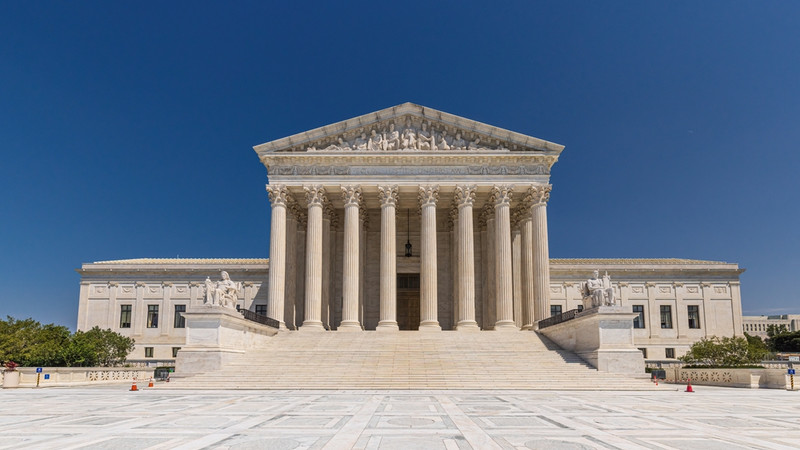
In a seismic shift shaking the political landscape, the Supreme Court has issued a groundbreaking ruling with the potential to dismantle decades of race-based redistricting, leaving Democrats reeling. This landmark decision, following the Callais ruling, sends a clear message: the era of race-engineered electoral districts is over. With two additional lower court decisions vacated, the implications of this judgment are vast and profound, threatening the very foundation of the Democratic Party's electoral strategy.
- The Supreme Court invalidated two lower court decisions, affirming Callais as the definitive law governing electoral maps.
- This decision eradicates race-based gerrymandering, posing an existential threat to Democrats' electoral prospects.
- The ruling's reach extends beyond congressional seats, potentially reshaping state and local districts nationwide.
The Supreme Court's latest orders, issued in the wake of Callais, have set off alarm bells for the Democratic Party's race-based redistricting efforts. In Mississippi, a three-judge panel had sided with plaintiffs supported by the NAACP, claiming certain legislative districts diluted the black vote. The lower court demanded Mississippi redraw its maps, a move that essentially sought to create guaranteed Democrat seats by exploiting the notion of vote dilution—a tactic long used to ensure racial justice. However, the Supreme Court vacated this order, declaring it a relic of pre-Callais judicial activism.
In North Dakota, Native American voters challenged legislative districts, alleging political power dilution. The 8th Circuit Court of Appeals had ruled that only the federal government could enforce Section 2 of the Voting Rights Act, not private parties. Yet, the Supreme Court vacated this ruling too, reinforcing Callais as the prevailing legal standard. These decisions, both 8-1, with Justice Ketanji Brown Jackson as the lone dissenter, signify a transformative legal shift. Justice Jackson, isolated in her dissent, argued for Court intervention to resolve confusion—a notion dismissed by her peers, who recognize the clarity Callais brings. The Supreme Court's actions are not mere procedural maneuvers, but rather a methodical dismantling of the race-based electoral manipulation architecture Democrats relied on for decades.
As we witness these significant shifts, it's essential to be prepared for uncertain times ahead. Just as the political landscape is changing, so too can disaster strike when we least expect it. Make sure you and your family are ready to face any situation. Grab your Emergency Sleeping Bag here -> https://offer.sierramadreresearch.com/dr-steve-turley-esb. This lightweight, waterproof bag could be the lifeline that keeps you warm, dry, and alive during emergencies.
Stacey Abrams, a prominent Democrat, is candidly expressing alarm over the ruling's extensive repercussions. Callais doesn't just address federal congressional lines; it establishes a constitutional principle that race cannot predominate in drawing electoral districts. This extends to state legislative, county commission, school board, and city council maps. Hundreds of districts drawn under the old Section 2 standard now stand legally vulnerable. The ACLU warns that the ruling affects all levels of election systems across the nation. Abrams' organization, Fair Fight, forecasts Republicans could gain up to 30 Congressional seats by 2026 and 2028, with even more significant shifts in local government.
The American Spectator poses a daring question: Could the Democrats survive the Callais ruling? The answer is a stark possibility of structural collapse as a viable national party. Data from Ballotpedia reveals that 148 House districts were drawn with race as a predominant factor, 122 of which are held by Democrats. This represents more than half of the Democrats' House caucus, built on a race-based cartography foundation now condemned by the Supreme Court. Democrats' House coalition wasn't built on policy or persuasion but on racially engineered geography, securing a judicially guaranteed structural advantage. Callais has obliterated this advantage.
The immediate impact on congressional seats may unfold over a full cycle, but 2030 looms—a full decennial census year where every congressional district will be redrawn under the new precedent. The Democrats' structural advantage will vanish, affecting fundraising, media presence, candidate recruitment, and national party relevance. Callais, combined with a clean 2030 census, could spell checkmate for the Democrats—a setback from which they may never recover.
© 2025 TurleyTalks.com. All rights reserved.
Gain the Clarity, Confidence, and Community you need to lead with courage and awaken a new conservative age. Join the movement to fight back and reclaim freedom at fight.turleytalks.com!