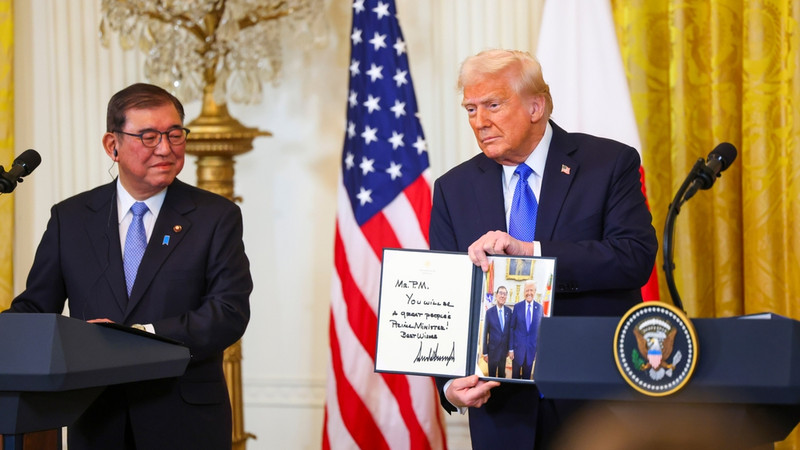
In a groundbreaking announcement, President Donald Trump has secured what he claims to be the largest trade deal in history with Japan, a move that could reshape the economic landscape of the United States. This deal, valued at a staggering $550 billion, promises to bring significant investment into American industries while simultaneously slashing tariffs that have long been a burden on trade. The implications of this agreement extend far beyond mere economics; it signals a potential shift away from globalism and towards a more nationalist economic framework.
- Trump has negotiated a $550 billion trade deal with Japan, which includes a significant reduction in tariffs.
- The agreement is expected to create hundreds of thousands of jobs in the U.S., particularly in the auto and agriculture sectors.
- This deal represents a shift towards mercantilism and economic nationalism, challenging the liberal international order.
In a world where nationalism, populism, and traditionalism are on the rise, Trump’s “latest trade deal” is a bold move that defies political norms. With a single stroke of a pen, he has opened the floodgates for $550 billion of foreign investment into American communities while slashing unfair tariffs overnight. Sound impossible? President Trump just did it, and the ramifications for the U.S. economy and the future of globalism are profound.
Just hours ago, Trump announced this monumental agreement with Japan, which will see the nation invest an astonishing $550 billion in U.S. industries. In return, Japan will face a flat, reciprocal 15% tariff on its exports, a significant reduction from the 25% tariff Trump had previously threatened. This deal also includes provisions for Japan to open its markets to American cars, trucks, rice, and other key agricultural products that have long been protected.
To put this in perspective, $550 billion is roughly equivalent to the entire economy of Sweden. The deal is projected to create hundreds of thousands of new jobs in the U.S., particularly in the auto and agriculture sectors, with revenues from the Japanese tariffs alone potentially exceeding $22 billion annually based on 2024 import volumes.
Treasury Secretary Scott Bessent highlighted Trump’s success in these negotiations, noting that the president anchored the discussions with a firm threat of a 25% tariff if no agreement was reached. Japan ultimately blinked, offering investment cash and access to its notoriously closed markets in exchange for a more favorable tariff rate. Critics may label this approach as coercive, but many Americans see it as a strategic use of leverage.
Despite the legacy media's attempts to downplay this monumental trade deal, more people are recognizing that what passes for journalism today often resembles politically charged activism. The significance of Trump’s trade agreements extends beyond economic gains; they represent a return to a nationalist-based world order. For decades, the liberal international order has promoted free trade and shrinking borders, which have kept wages stagnant while corporate profits soared. Trump’s deal flips that narrative, reviving mercantilism—the idea that national power grows when the state drives hard bargains to boost domestic surplus.
By reestablishing trade as an extension of national security, Trump is signaling a departure from the “rules-based” altruism of the past and ushering in an era of hard-edged reciprocity. The winners in this new economic landscape are American workers in steel, autos, and agriculture, as domestic manufacturers stand to gain $550 billion in fresh capital for plants and infrastructure.
Meanwhile, Japan faces its own challenges. Prime Minister Shigeru Ichiba is under immense pressure to resign following a recent election, where the newly formed "Japan First" party, inspired by Trump’s policies, made significant electoral gains. This shift indicates a growing sentiment in Japan towards the Trumpian doctrine of civilization states, moving away from the globalist policies of the ruling Liberal Party. Japan's PM Ishiba vows to stay in office despite election debacle.
With Japan secured, Trump is now eyeing Europe and other nations, signaling that the 15-19% tariff range may become the new normal, replacing the under-2% tariffs of the liberal era. This shift could lead to hundreds of billions of dollars in revenue flowing into the U.S. Treasury annually.
Picture Main Street America five years from now: shinier factories, roaring tractors, and young families finally able to save for the future. This is the promise of what Trump has secured with this monumental trade deal, adding to his unblemished record of winning.
© 2025 TurleyTalks.com. All rights reserved.
Gain the Clarity, Confidence, and Community you need to lead with courage and awaken a new conservative age. Join the movement to fight back and reclaim freedom at fight.turleytalks.com!