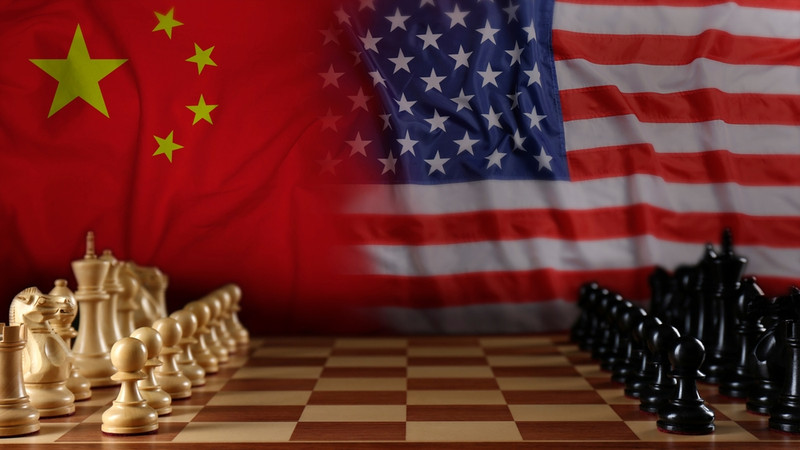
What if China could win the race everyone is watching—and still fail to overtake America? And what if America’s greatest advantage isn’t the one you think? Beneath the factories, financial markets, and the race for artificial intelligence lies a contest no economic scoreboard can settle. So who is really winning—and are we even watching the right race?
- The US boasts a larger economy by market exchange rates, yet China's economy surpasses in purchasing power parity.
- China's industrial and technological prowess is unmatched, but the US dominates in finance and AI innovation.
- The fundamental contest is between two civilizational visions: America's frontier spirit versus China's Tianxia.
Let’s begin with the economic size, where even the basic measurement changes the picture. The IMF's October 2026 estimates position America's economy at roughly $33 trillion, compared to China's $22 trillion at market exchange rates. However, when adjusted for domestic prices, China takes the lead. Thus, whether you compare dollar values or actual production, the answer varies. Convert both economies into dollars at standard exchange rates, and America appears larger due to its greater monetary wealth; yet, adjust for local price differences, and China's economy shows greater output.
Consider a haircut: a cheaper one in China provides the same basic service as a pricier one in America. Purchasing power parity (PPP) adjusts for these price differences, ensuring cheaper prices don’t automatically downsize an economy’s output. Market exchange rates are more relevant for evaluating international purchasing power, while PPP is better for comparing domestic production. Neither metric alone determines global supremacy.
Now, let's shift from spreadsheets to the factory floor. The International Federation of Robotics reports that China installed 354,000 new industrial robots in 2025, dwarfing America’s 38,500. These numbers reflect new installations, not the entire stock of active robots. Even so, the disparity is staggering. China is not just competing with inexpensive labor; its factories are adopting automation on an immense scale, transforming industrial capacity into a technological launchpad.
This capacity yields astonishing results. In 2024, all American shipyards combined built a mere five large oceangoing merchant ships. In stark contrast, one Chinese company—China State Shipbuilding Corporation—constructed over 250, more than fifty times as many. That's just one company, not China's entire industry. A single Chinese shipyard exceeds the shipbuilding capacity of all American shipyards combined.
Research from the Center for Strategic and International Studies highlights how China's commercial shipbuilding sector bolsters its naval capabilities, with some yards producing both merchant vessels and warships. This doesn’t mean every container ship is a weapon. It indicates commercial demand supports skills, infrastructure, and suppliers crucial to military production. Thus, industrial and security competitions are often intertwined.
Rare earths further illustrate this connection. According to the International Energy Agency, China accounted for 91 percent of global refining of magnet rare earths in 2024. The distinction here is refining, not just mining. A mineral deposit doesn’t become an industrial supply chain without processing expertise, equipment, and customers. Technological sovereignty demands an ecosystem. Owning resources is less significant if another nation controls the intricate processes that render them useful. In manufacturing and refining, China is unrivaled. Yet, the financial realm tells a different story.
IMF data shows the dollar represented nearly 60 percent of global foreign exchange reserves in 2026's second quarter, while China's yuan accounted for about 2 percent. Foreign exchange reserves function as a country’s financial emergency fund, with central banks holding assets like gold and foreign currencies to manage international payments or support their own currency in crises. After Russia's incursion into Ukraine, the Biden administration froze approximately $20 billion in Russian foreign assets. The USD remains the world’s default reserve currency, and BRICS has yet to offer a viable alternative.
Combine all global foreign-currency reserves into a hypothetical $100 pot: about $57 would be in USD compared to just $2 in yuan. Clearly, manufacturing leadership hasn’t translated into monetary dominance.
Artificial intelligence reveals another surprise. Stanford's 2026 AI Index records roughly $286 billion in American private AI investment during 2025, compared to a mere $12 billion in China. Washington has limited China’s access to advanced chips and chipmaking equipment through export controls, aiming to maintain a computing advantage with both economic and military implications. The logic is clear: a nation lacking frontier processors conducts fewer experiments, trains smaller models, and progresses slower. These controls have real costs. China still struggles with advanced semiconductor fabrication, high-bandwidth memory, manufacturing equipment, and AI chip software ecosystems. Its leading firms often connect more, less capable processors, consuming more electricity and navigating supply constraints. Thus far, America leads in AI production and innovation, while China excels in distributing AI like Kimi 3 and DeepSeek globally.
But the real contest transcends chips, ships, and finance. It's about something else entirely. America and China embody two distinct civilizational visions, approaching economy and technological innovation differently. America champions a discovery civilization, treating the frontier as a symbol of possibility: the next invention, breakthrough, and horizon. This frontier spirit is embedded in America's DNA, from its founding as a Shining City on a Hill.
As we consider these civilizational differences, it is crucial to also think about our financial futures. The national debt has skyrocketed in recent years, threatening the security of Americans’ retirement accounts. But you don't have to wait around and hope it gets fixed. You can protect your retirement today. Get instant access to the report now: Prepare Your Retirement Now: Debt Will Hit $40T in 2026. In this report, you'll learn ways to take control of your financial future even as debt continues to balloon.
Consider President Donald Trump's administration promoting exports of comprehensive American AI packages—hardware, models, applications, and standards included. This policy transcends selling isolated products; it aims to establish relationships within a broader technological system. These relationships can become conduits for influence, expectations, and institutional preferences.
Yet, the world isn't a passive audience awaiting a winner. Australia exemplifies the complexity of dividing the map into two camps. It identifies China as its largest trading partner while considering the US its closest ally and principal strategic partner. Australia opts for China in trade and America for security. These relationships coexist. Economic dependence doesn’t automatically dictate security alignment, nor does security alignment negate commercial incentives.
Currently, the US offers both military and financial security globally, a feat China cannot match. China excels in production and manufacturing, but it falls short in financing and defense. Consequently, these civilizations provide distinct options for global players like Australia and India—India being a BRICS member with China, yet allied with the US through the Quad.
However, both civilizations grapple with renewal challenges. The IMF warns of China’s aging population, property-sector troubles, and diminishing investment returns threatening its growth model. It also highlights America's persistent fiscal deficits and rising public debt. These are different vulnerabilities, not proof of impending collapse. They raise the crucial question: can a society maintain the institutions and shared commitments necessary for enduring capabilities?
Today's lead isn’t tomorrow's guarantee. So who is truly winning? China wields formidable industrial and supply chain advantages; America retains extraordinary strengths in finance, technological investment, and unparalleled military power. The decisive question is who can transform those strengths into a civilization capable of renewal—and a future others wish to join. Ultimately, the contest isn’t merely about who builds tomorrow, but whose vision of human life gives tomorrow its purpose. And that, I believe, is America's decisive edge over China. Beijing may see itself as the world's center, but there’s only one shining city on a hill!
© 2026 TurleyTalks.com. All rights reserved.
Gain the Clarity, Confidence, and Community you need to lead with courage and awaken a new conservative age. Join the movement to fight back and reclaim freedom at fight.turleytalks.com!
Turley Talks Coffee: Shop Bold Roast at https://turley.pub/TurleyTalksCoffee