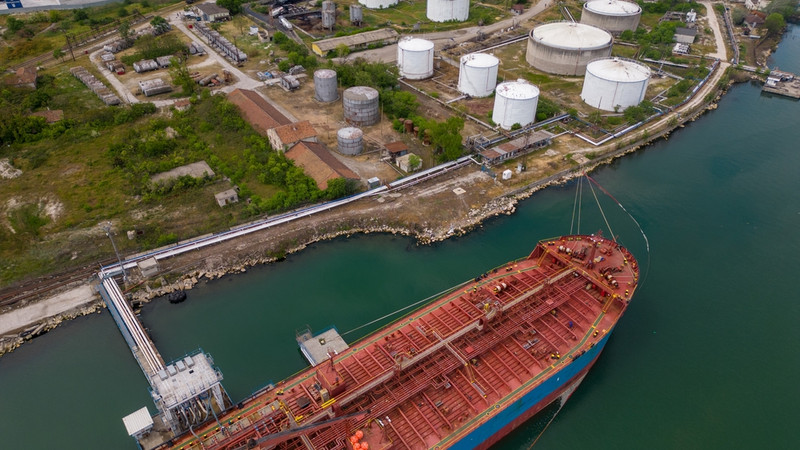
In the midst of tense U.S.-Iran negotiations over Tehran's nuclear ambitions, the United States Navy has taken decisive action on the high seas, seizing an Iranian-affiliated tanker. But the real game-changer? Another nation has now joined the fray, catching Tehran completely off guard and reshaping the global power dynamics.
- The U.S. Navy seized the Veronica III, a tanker part of Iran's shadow fleet, used to smuggle sanctioned oil.
- Iran's aggressive actions have been countered by a U.S. naval presence and unexpected involvement from India.
- The Indo-Abrahamic alliance marks a new strategic coalition challenging Iran and its allies.
On February 15th, U.S. naval forces boarded the Panama-flagged Veronica III in the Indian Ocean. Officially, it sails under Panama's banner, but in reality, it's a cog in Iran's "shadow fleet," a network of ghost ships smuggling sanctioned Iranian crude oil under false flags. Authoritarian regimes like Iran heavily rely on such illicit revenue streams, bypassing the need for domestic consent, which is critical for their survival. These shadow tankers enable Iran to funnel billions in off-the-books oil sales, sustaining both its regime and proxies like Hezbollah and Hamas, which destabilize the Middle East. However, this clandestine operation is no longer viable.
The Pentagon confirmed the seizure of the Veronica III, flagged for transporting vast quantities of Iranian and Venezuelan crude. This ship, intricately linked to both nations, has been evading sanctions, primarily ferrying Iranian crude to Chinese buyers. Most recently, it was spotted near Venezuela, fleeing the coast amid a U.S. quarantine on Venezuelan oil following Maduro's arrest. American forces meticulously tracked the ship, culminating in a strategic pre-dawn boarding. This is part of Operation Southern Spear, an initiative that has already seen the capture of multiple ghost ships violating the Venezuelan oil blockade.
Iran's provocation hasn't gone unanswered. On February 3rd, six armed Islamic Revolutionary Guard gunboats attempted to commandeer a U.S.-flagged tanker in the Strait of Hormuz. The captain, recalling the resolve of the current U.S. administration, evaded capture with the USS McFaul providing swift escort. That same day, the U.S. Navy downed an Iranian drone encroaching too close to the USS Abraham Lincoln, demonstrating zero tolerance for Iran's aggressive posturing.
The following day, Iran seized two foreign tankers, threatening a "massacre" in the Strait of Hormuz, just as U.S.-Iran talks were set to begin in Oman. This bid for negotiating strength backfired spectacularly. Iran's miscalculation was underestimating the response from a new player—India. In an unexpected move, India announced the seizure of three Iranian shadow fleet tankers west of Mumbai, deploying a formidable array of ships and aircraft for surveillance. This marks India's proactive stance in enforcing maritime security and aligns them with U.S. efforts.
Now, as the Patriot Economy continues to grow, are you part of it? Shop the Turley Talks Store for statement-making Patriot Wear and unbeatable bundle deals. Every purchase supports aligned values and strengthens the movement. Get yours today!
President Trump has reinforced this stance by deploying a carrier strike group to the region, labeling it an "armada." The U.S. Maritime Administration has warned American ships to avoid Iranian waters, not as a retreat, but as a prelude to making the area inhospitable for the Revolutionary Guard. Analysts have dubbed this coalition the "Indo-Abrahamic noose," a strategic alliance between India, the UAE, and the U.S., countering the influence of Iran, China, and Russia in Western Asia.
Internally, Iran faces its most severe crisis since 1979, with a plummeting currency, a dire water shortage, and a merchant class that has turned against the mullahs. Externally, the U.S. and India are choking Iran's economic lifelines, seizing tankers, and maintaining a formidable naval presence. This dual-front pressure ensures any negotiations in Oman occur on U.S. terms, signaling the collapse of the liberal internationalist order.
The seizure of the Veronica III underscores a new civilizationalist order, where nations enforce sovereignty beyond traditional frameworks. The message is clear: breach our sovereignty, and we will pursue justice, even across oceans. With India now involved, Iran’s position is increasingly precarious, suggesting they might seek an off-ramp, though finding one in these circumstances will be challenging.
The unfolding situation reaffirms the rise of a Trump-inspired civilizationalist order, fundamentally altering the geopolitical landscape. We'll be watching closely as these events continue to develop, with the world witnessing the end of an era and the dawn of a new strategic reality.
© 2025 TurleyTalks.com. All rights reserved.
Gain the Clarity, Confidence, and Community you need to lead with courage and awaken a new conservative age. Join the movement to fight back and reclaim freedom at fight.turleytalks.com!