
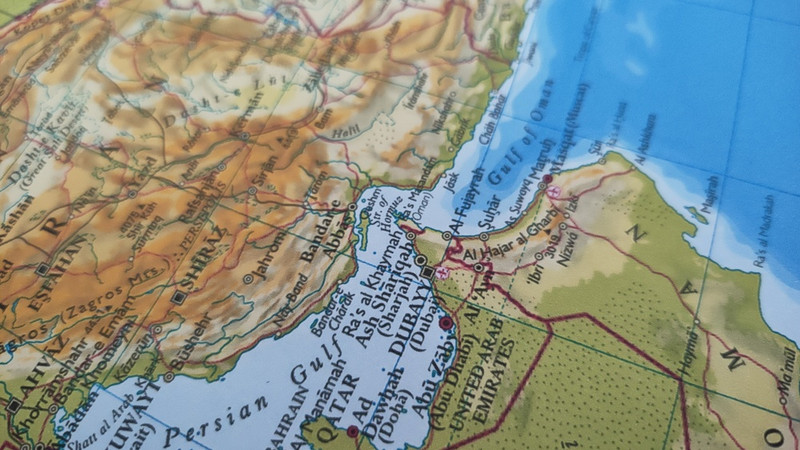
Something extraordinary is unfolding in the United Arab Emirates, beyond the mountains and the Persian Gulf, and crucially, beyond the Strait of Hormuz. For decades, Iran has considered the Strait its ultimate weapon—a narrow maritime gateway through which the economic lifeblood of its neighbors must pass. But a revolutionary new infrastructure strategy is challenging that assumption, featuring massive ports, freight trains, bonded highways, thousands of trucks, and pipelines carrying millions of barrels of oil directly to the open ocean. This is not just a new container terminal; it’s a nation engineering its escape from a geographic trap, with significant consequences for Iran, Dubai, and the emerging Trump world.
- The UAE is building a bypass around the Strait of Hormuz to counter Iran's geographic advantage.
- This initiative is part of a larger shift towards civilizational blocks, emphasizing strategic independence.
- The new infrastructure includes ports on the UAE's eastern coast, increasing resilience against potential threats.
In the United Arab Emirates, we see a perfect example of how nations adapt to a world forged anew. The old globalist order urged countries to surrender sovereignty, trust international institutions, and rely on a managerial elite to keep sea lanes open. Those days are over. The emerging world order pivots around civilizational blocks, characterized by unprecedented military strength, strategic independence, and the recognition that no hostile regime should hold an entire civilization hostage. To grasp what has transpired, consider Dubai's geographic vulnerability. Dubai, one of the world's wealthiest and most advanced cities, thrives through Jebel Ali, the Middle East's largest container port. In 2024, Jebel Ali handled 15.5 million
twenty-foot equivalent units, linking Asia's factories with Europe and the Middle East. However, this port lies within the Persian Gulf, requiring vessels to pass through the Strait of Hormuz, a narrow passage separating Iran from the Musandam Peninsula of Oman.
In 2024, approximately 20 million barrels of oil per day traversed Hormuz, representing a fifth of global petroleum consumption and the world's liquefied natural-gas trade. Iran has long treated this geography as an insurance policy, repeatedly threatening to close the strait whenever it felt cornered. While Tehran cannot control the waterway entirely, the mere threat has driven up insurance costs and rattled global energy markets. The UAE, however, is constructing an alternative. On July 22, DP World announced an agreement with the Fujairah Ports Authority to develop two new terminals on the UAE's eastern coast. The first terminal will be a deep-water container and multipurpose facility at Al Ruwais, and the second a general-cargo terminal at Dibba. Crucially, these locations face the Gulf of Oman and the open Indian Ocean, allowing ships to bypass the Strait of Hormuz entirely.
The scale of this project is remarkable. The Al Ruwais terminal is designed to handle up to 2.5 million containers annually, along with 1.7 million tonnes of general cargo and 190,000 vehicle-equivalent units, while Dibba is expected to add another 3.6 million tonnes of general-cargo capacity. Once operational, this development will increase DP World's total container-handling capacity in the UAE from 19.4 million to nearly 22 million shipping containers—a 13 percent increase. If Hormuz becomes obstructed or too dangerous, the UAE will have a powerful second front door facing the open ocean. This backup system need not replace the primary one to neutralize a threat. By redirecting a substantial minority of high-priority cargo through Fujairah, Iran's ability to paralyze Dubai diminishes from an economic death sentence to a solvable logistical problem. This strategy is not just about bypassing Hormuz; it aligns with a broader civilizational realignment reshaping global order in unprecedented ways.
As we witness these powerful shifts, it's essential to stand strong and support the movement fostering this change. Get yours today!
The UAE's strategy has already proven effective in the energy sector. In 2012, Abu Dhabi opened the Habshan–Fujairah crude-oil pipeline, a 380-kilometer route connecting inland oil fields directly with Fujairah. Capable of transporting 1.8 million barrels per day, this pipeline bypasses Hormuz entirely. The UAE is now accelerating work on a second eastbound pipeline to double its crude-export capacity through Fujairah by 2027. The full picture reveals oil moving beneath deserts through pipelines, containers traversing the country by rail and truck, and ships unloading at eastern ports beyond Iran's geographic leverage. This layered national network is extraordinarily difficult to isolate. The genius of strategic redundancy lies in not betting economic survival on a single port, pipeline, or passage, but in creating multiple overlapping routes that no adversary can disable with one move.
This transformation fits perfectly into the regional metamorphosis. Saudi Arabia can move oil westward through its East–West pipeline towards the Red Sea, while the UAE directs crude and commercial cargo eastward to Fujairah. Concurrently, the United States under President Trump asserts freedom of navigation, expands American energy dominance, and increases the cost for Iran to weaponize the global economy. Though Trump did not design the Fujairah terminals, the project reflects the strategic logic his presidency accelerated: sovereign nations building real capacity, protecting their interests, and refusing dependency on hostile regimes. There are even proposals for the "Strait of Union," an artificial waterway carving a direct maritime corridor across the UAE between the Persian Gulf and the Gulf of Oman.
For over forty years, Iran believed geography assured its relevance, assuming the world would always have to engage with Tehran because Hormuz couldn't be moved. While Tehran was technically correct, it failed to see that flows through Hormuz could be redirected. Pipelines, ports, railways, and highways can transform an unavoidable chokepoint into just one option among several. The real story in Fujairah is not Dubai escaping geography overnight, nor Hormuz becoming irrelevant tomorrow. It's the quiet, methodical construction of a new economic architecture where Iran's ability to intimidate its neighbors diminishes with every mile of railway, new terminal, truck corridor, and barrel flowing directly to the open ocean. Iran banked on closing one narrow door; the UAE’s response is to build another. And once that eastern door is fully open, Tehran may find it impossible to close the region off again.
© 2026 TurleyTalks.com. All rights reserved.
Gain the Clarity, Confidence, and Community you need to lead with courage and awaken a new conservative age. Join the movement to fight back and reclaim freedom at fight.turleytalks.com!

