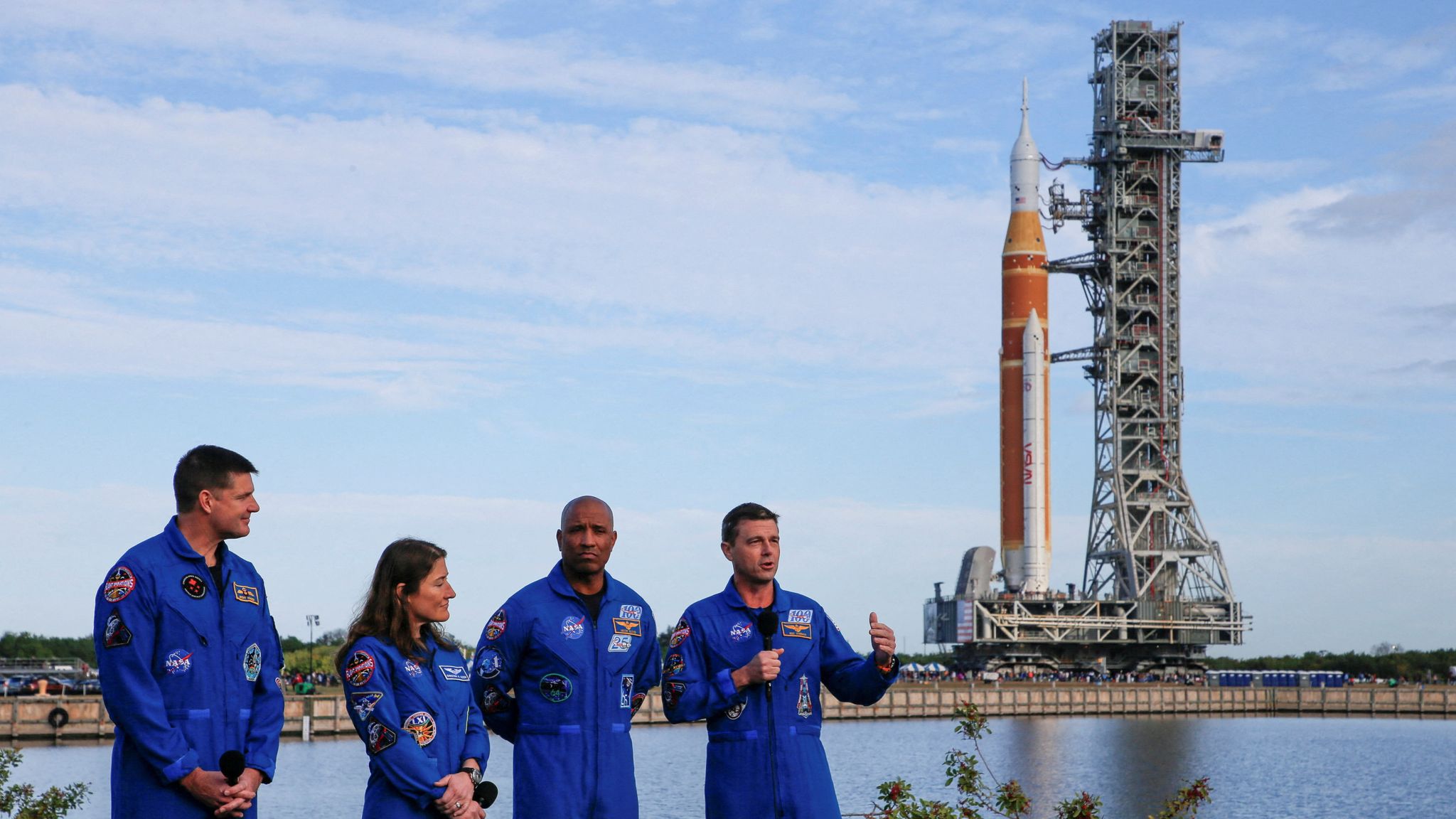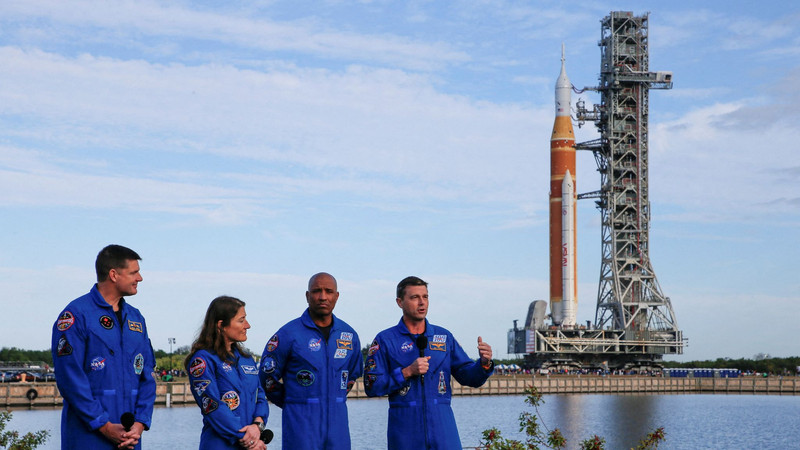
History was made on April 1st, as four astronauts embarked on a mission that hasn't been attempted for over fifty years. They are soaring towards the Moon, a feat of human ingenuity that promises to reshape our civilization's future. This is not just about space exploration; it's about global power dynamics and the race for cosmic dominance.
- Four astronauts have begun the first crewed lunar mission since 1972, breaking records in space travel.
- The mission is a pivotal moment in the geopolitical race for lunar resources, with the U.S. and China vying for supremacy.
- This mission sets the stage for a new era of cosmic order, where civilizational influence extends beyond our planet.
Yesterday, Commander Reid Wiseman, pilot Victor Glover, mission specialist Christina Koch, and Canadian astronaut Jeremy Hansen launched aboard NASA's Orion capsule, marking the first crewed lunar mission since Apollo 17 in 1972. Strapped into the massive 322-foot Space Launch System rocket at Kennedy Space Center, they embarked on a journey that had been awaited for over half a century. A tower of fire and thunder signaled the end of fifty-three years of anticipation as the rocket lifted off, shaking the Florida coastline.
But this event isn't just about space exploration. It's a story of power—civilizational power. The legacy media might miss it, but this mission could be the most significant geopolitical event of the century, overshadowing developments in Tehran, Beijing, or Brussels.
At its peak, the crew will travel a staggering quarter of a million miles from Earth, surpassing the Apollo 13 record by 1,500 miles. For 56 years, no one had ventured farther from Earth than those astronauts in 1970. Now, this crew is breaking that record, spending up to 50 minutes on the Moon's dark side—beyond radio contact. It's a test of human endurance and technological prowess, with Christina Koch making history as the first woman to travel to the Moon, and Jeremy Hansen as the first Canadian to leave Earth's orbit.
These achievements are civilizational milestones, not mere historical footnotes. The mission is about what comes next and who will lead in this new frontier. China's Chong-a 7 mission is targeting the same destination—the lunar south pole, where NASA plans to establish a permanent Artemis base. This site holds precious resources like water ice, which is not just for drinking but essential for rocket fuel.
As we witness this monumental shift in our cosmic journey, it’s crucial to stay informed about the developments that will dictate our future. Stay ahead with Patriot News Daily! Get the latest breaking news and insider updates delivered straight to your inbox—every single day. Stay informed, stay empowered, and never miss a critical update. If you want the latest updates and some behind-the-scenes goodies, head over to turley.pub/news and sign up for our newsletter. Big things are always coming!
Water ice, through electrolysis, provides deuterium—a fuel for nuclear fusion reactors—and the lunar surface is rich in Helium-3, a rare isotope for clean fusion reactions. Whoever mines these resources first will monopolize a limitless fuel source, crucial for missions throughout the inner solar system. Control of the lunar south pole equates to control over cosmic travel, aligning with the Trump administration's vision for a $20 billion Moon base aiming for a sustained human presence.
This mission is intertwined with the concept of the CivCosm, or civilizational cosmocracy, a framework for understanding 21st-century conflicts as battles between civilizations, not just nations. These are driven by theopolitics, technopolitics, and astropolitics. NASA's Artemis program and China's Chong-a program aren't just scientific endeavors; they are competing civilizational projects.
The United States, supported by the Artemis Accords, promotes a coalition of over 50 nations focused on transparency and market-driven frameworks for space resources. This approach, dubbed cosmic technopopulism, leverages the Musk-Trump synthesis, where private enterprise and state power work in tandem for civilizational expansion. In contrast, China and Russia, along with their Belt and Road partners, pursue a state-directed model. Here, technology is a tool for civilizational ascent, tied to China's national rejuvenation project.
These two blocs aren't just racing to claim lunar craters; they are vying to define life beyond Earth. Geopolitics is morphing into astropolitics, shaping a cosmic order. The question isn't if humans will become multiplanetary—they will. It's about whose cosmology will guide this expansion. With this mission, America has fired the opening shot in this new cosmic era.
© 2025 TurleyTalks.com. All rights reserved.
Gain the Clarity, Confidence, and Community you need to lead with courage and awaken a new conservative age. Join the movement to fight back and reclaim freedom at fight.turleytalks.com!